
Camping Etiquette
Some people camp for solitude and connection with nature. Some camp for connection with others. Some are just learning and don’t know the ropes. Whatever your reason for camping, make sure you learn and practice proper camping etiquette.
In this Guide:
Campfire etiquette
Respecting space
Pooping and peeing
Trash and waste
Pets and dogs
Nighttime rules
Wildlife
Water sources
Resources
Glossary
What is camping etiquette
Camping is like any other recreational activity – there’s some written, and unwritten rules, that help guide campers to have the best experience possible. Below is an overview of how to treat others and the space around you when going camping.
Basic Rules For All
- Leave no trace
- These are the golden rules for camping, no matter where you are. Please learn, practice, respect, and share these rules. Read more about them here.
- Respect individual campsite and campground rules
- Each public land, campground, or camping area all share similar rules, but may have have specific regulations depending on the region or time of year that are unique to that area. Call the campsite, local ranger station, or visit their websites to find out the specific rules and regulations around that camping area.
- Oftentimes, ordinances from the County will supersede certain campground rules. For example, a campground might allow fires, but if the surrounding County has a fire ban, then that applies to that campground.
Campsite etiquette
- Choosing a campsite
- For nature’s sake, please choose a campsite that is at least 200 feet from any water sources, and 200 feet from any trails.
- For other campers’ sake, please try to choose a site that is as out of sight and out of sound of your neighbors as is possible.
- Regardless of how well you abide by the above, understand that other people are out there camping and you’ll likely see them.
- Booking or reserving a campsite
- Please only book what you need, and do not book extra campsites for “insurance” or “extra space.” Everyone is eager to use the few facilities that are available for all of us, and we need to be mindful of others that wish to use the facilities.
- Arriving at your campsite
- If you arrive on time, please set up your camp in a respectful and quiet manner.
- Keep the noise to a respectable level.
- Turn off your vehicle (no one wants to breath the exhaust or hear the engine rumble).
- If you arrive late:
- Keep the noise to a minimum, including your voices.
- Do not slam your car doors.
- Use your headlamps and softer lights. Do not shine lights into other campsites or tents.
- Abide by the campgrounds’ or areas quiet hours and rules.
- Do not chop wood or doing any excessive activities that can be done in the day time.
- If you arrive on time, please set up your camp in a respectful and quiet manner.
- Departing your campsite
- When departing your campsite, please be mindful of your noise, car, lights, and activity levels.
- Please leave the place better than you found it, and remove any trash or extra items (remember, there is NEVER a service that removes your trash on public lands – YOU are responsible for trash removal).
- If possible, be a hero and donate any unused firewood or snacks to your camping neighbors when you depart.
- If you’re departing early:
- Keep the noise to a minimum, including your voices.
- Do not slam your car doors.
- Use your headlamps and softer lights. Do not shine lights into other campsites or tents.
- Abide by the campgrounds’ or areas quiet hours and rules.
- We all love to chat with our neighbors if it makes sense. But please be mindful and keep the chat to a minimum when people are leaving.
- Noise levels
- Depending on your camping trip you may be laughing loud with friends, reading a book while listening to the creek, or gently playing guitar. Whatever the reason for your trip, please know that not everyone is there for the same reason, and your noise levels affect everyone.
- Solo campers seeking quiet? Expect there might be other voices or other noise. Camping with a group of 10 friends for a reunion? Expect there may be other campers seeking solitude and quiet.
- Respect the quiet hours established by a campground.
- Abide by those same quiet hours into your backcountry camping trips.
- Cleanliness
- Clean up after yourself, and leave your campsite clean and clear for the next camper.
- Remember, your public lands and camping areas are just that – public. There is NEVER trash service. YOU are responsible for trash removal, always. Treat your campsite the way you’d like to find it and clean up any trash, spills, or grease, and tidy up for the next camper.
- Be a true hero, and pick up trash you didn’t leave yourself (sadly, you’ll find it).
Campfire etiquette
- Confirm if fires are allowed
- No matter where you camp, please confirm beforehand with the local campsite or ranger station if fires are allowed.
- In some areas, fires are never allowed no matter which time of year. Stoves only.
- Otherwise, it will depend on the local, regional, and campsite regulations established at that time.
- Fire restrictions follow this hierarchy:
- Campsite restrictions
- County restrictions
- State restrictions
- Only make fires in designated areas or fire rings
- Don’t make the fire too big
- Be aware of wind and smoke
- Be mindful of your neighbors
- Don’t bring wood from outside the region
- Do not EVER cut down live trees or branches
- Never leave a fire unattended.
- Make sure your fire is COMPLETELY out. Soaked, saturated, and cool to the touch with bare hands.
Respect Each Other’s Space
- Acknowledge other people who are camping
- First, if it makes sense, acknowledge other campers with wave and friendly hello! We’re all here for a short time, and a friendly acknowledgement can go a long way.
- Recognize we all camp for different reasons
- Some camp for solitude, or for a retreat with loved ones, connecting with friends, connecting with nature, going through some feels. Whatever your reason, please recognize that the camper next to you may have a different reason for being there. Some may wish to be social, some may wish for solitude. Don’t expect everyone to be as solitary, or social, as you are.
- Do not walk through someone’s campsite without permission
- Space can be tight. If you wish to walk through someone’s campsite, please only do so with permission from the camper.
Pooping and peeing
- Always use facilities if available, for both peeing and pooping.
- Peeing in nature:
- Pee at least 200 feet away from all campsites, trails, and water sources (streams, lakes, rivers).
- Pooping in nature:
- Always use a WAG bag if you can – human waste is an enormous issue in the backcountry around the globe and will not improve unless we change our ways. Not sure what a WAG bag is? Read here.
- If you must go outside:
- Dig a cat-hole at least 6-8 inches deep (this is the ideal zone in which the microbes can break down organic waste effectively, although the depth may differ depending on what type of soil or ecological zone you are in).
- Bury your toilet paper with your waste.
- Fill in the cat-hole with dirt you removed, and compact it down as best as possible.
- If you’re a true friend, please place a stick or rock on top to indicate, “this spot has been used!”
- Please poop at least 200 feet away from all campsites, trails, and water sources (streams, lakes, rivers).
- Want a full guide on pooping and peeing in nature? Check our article here.
- Always pack out your pet waste:
- Pet waste can disturb wildlife and their normal habits and pathways for miles around.
- Pet waste can contaminate the ground and waterways.
Trash and Waste
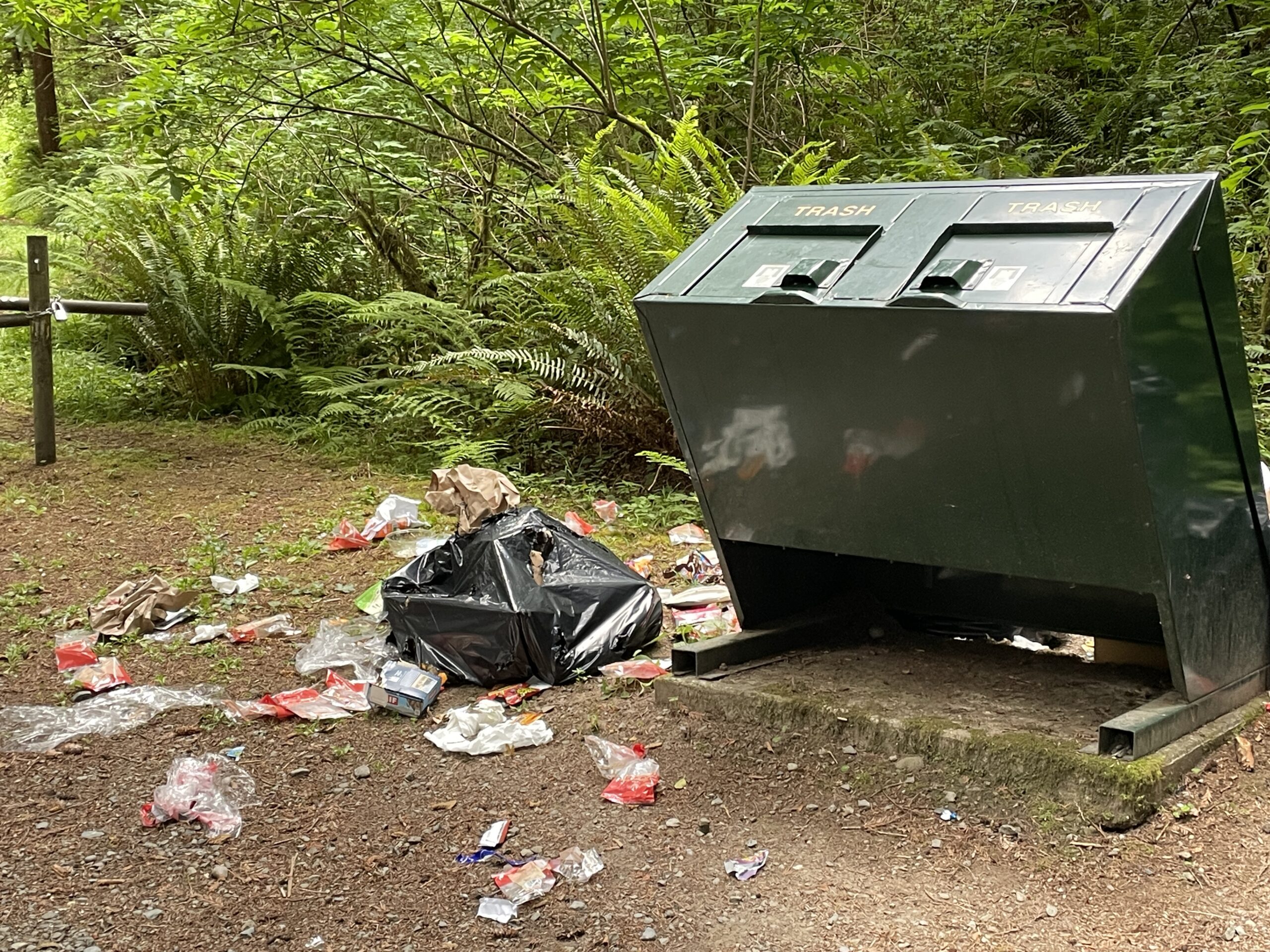
- You are ALWAYS responsible for removing your trash and waste from a campsite, no matter if it is at a campground, backcountry, or any type of camping.
- If there are repositories, dumpsters, and trash cans, please use them and dispose of all trash and recycling.
- If there are not any trash or recycling receptacle available, then you are fully responsible for taking your trash and recycling with you to an appropriate place.
- This applies to dog and pet waste as well.
- Emphasis: There is NEVER any trash service when camping. You and YOU alone are responsible for your trash, no matter if you’re at a campground, or in the backcountry.
Pets and Dogs When Camping
- Dogs will bark. But if you have a dog that cannot stop barking or you’re unable to control, then please do not bring them camping. Regardless of your personal tolerance level for dogs barking, this can disturb wildlife and other campers experiences who may have planned this trip for months or years. Please, do not be that dog owner.
- Please keep your dog on a leash or restrained. As much as your camping neighbors might love dogs, it is not acceptable to let your dog peruse aimlessly through someone else’s camp.
- Pick up your dog waste and dispose of it properly (see rules above on Pooping and Peeing).
Nighttime Rules and Quiet Hours
- Respect the quiet hours established by a developed campsite or campground.
- If you are camping in the backcountry, please abide by the same quiet hours that are typically found at a developed campground.
- Noise is inescapable – footsteps, zipping up a tent, etc. Please make as little noise as is possible given the circumstances.
- Lighting:
- We all need a light source or two when camping, but nothing kills the mood more than abrasive and excessive lighting. Please do not be that camper who lights the sky.
- Do not bring flood lights. No, you do not need them.
- Do not aim your lights towards your neighbors.
- Turn off your heavy and bright lights at quiet hours.
- Use your red lights, or softer lights, during the quiet hours.
Wildlife At Your Campsite
- Never ever ever feed wildlife. Not even the squirrel or crow who’s approaching your campsite like a food truck. Read more on why this is a terrible thing to do.
- Never ever leave your campsite without storing and securing your food, scented items, or trash.
- Never approach wildlife for a photo op or selfie. If I need to explain this, please leave my site.
Water Sources
- Do not camp within 200 feet of any natural water source.
- Do not wash your dishes in any natural water source.
- If water spigots are available at a campground, do not wash your dishes there, nor conduct personal hygiene there.
- Do not go to the bathroom within 200 feet of water sources. Human feces and pee are not a welcome addition to natural water sources and can be a significant contributor to illnesses or worse.
Resources
Other useful camping guides:
Glossary
Click to expand
- Car camping – Driving up to a camping area and packing your gear in a car. This can be at a designated campground, primitive campground, or on your own as “dispersed camping” (see below). Ultimately, anywhere you camp with your car is “car camping.”
- Developed campgrounds – A designated campground with basic amenities and facilities including fire rings, vault toilets, tent platforms, potable water spigots, firewood for sale, and picnic tables. Oftentimes a campground host will be present to answer questions and collect fees. Amenities and facilities will vary depending on the campground. Many times these campgrounds will have electric sites and hookups for RV’s and trailers.
- Primitive campgrounds – A designated camping area with little to no amenities or facilities, usually just a place to set up your tent. You may get lucky with a fire ring, but these campgrounds are mainly to provide safe areas for people to camp in less accessible areas, and to help protect the landscape by preventing excessive dispersed camping.
- The Bureau of Land Management (BLM): The BLM oversees the largest portion of public land with about 250 million access. BLM lands are very accessible, and typically have fewer restrictions than you’d find on other public lands, which attracts a large variety of adventure seekers and campers. This includes (but is not limited) to places like Wilderness Areas and National Conservation Lands.
- The U.S. Forest Service: The USFS manages almost 200 million acres of land and provides some of the best places to camp among majestic forests, mountains, and a great way to escape the crowds. This includes (but is not limited) to places like National Forests and National Grasslands.
- The National Park Service: The NPS manages 85 million acres and over 425+ units, including some of the most scenic parts of the country like Olympic National Park and Zion National Park, as well as National Monuments and other gems. Everything from designated camping, backpacking, and car camping can be had in public lands managed by the National Park Service. This includes (but is not limited) to places like National Parks, National Rivers, and Wilderness Areas.
- Wilderness Areas: Each agency manages Federal Wilderness Areas with over 111 million acres and 806+ units, Wilderness Areas are the highest level of protection and designation public land can receive. Only accessible by foot traffic (no cars, bikes, or pets) it certainly offers the chance to see some of the most remote and pristine wilderness in the country, and is excellent for wildlife and natural ecosystems. However, the subject of management and the notion of “untouched” wilderness has received some criticism over the years as potentially not the healthiest way to manage wild lands.
- The US Fish and Wildlife Service: The US Fish and Wildlife Service manages 95 million acres on land, and over 755 million acres on water across all 50 US States, which is mostly composed of units called National Wildlife Refuges. The agency’s main goal is to protect and restore wildlife species and ecosystems. Everything from developed campgrounds, backpacking, and car camping can be found in National Wildlife Refuge Units and Wilderness Areas managed by the USFWS.