An Intro To Public Lands
The public land system in the United States has a total of 640 million acres. Managed between different government agencies and with a variety of designations and purposes, our public lands are one of the most unique ways to camp and connect with nature.
In this Guide:
What Are America’s Public Lands?
What Are The Types Of Public Land
A Brief History Of Public Lands
How To Camp On Public Lands
Rules On Public Lands
Reservations, Passes & Permits
Stewardship And Etiquette
What To Expect On Public Lands
How To Plan Trips On Public Lands
Resources
What Are America’s Public Lands?
Public lands are, at their most basic, all the acreage of land in America that is not privately owned. These lands are held in a public trust that is managed by the federal government, and they are owned by, and accessible, to all US citizens.
The 640 million acres of public land are primarily managed between four agencies; The National Park Service, The Bureau of Land Management, The U.S. Forest Service, and the U.S. Fish And Wildlife Service, with several dozen other agencies managing smaller portions of our public land such as the Bureau of Indian Affairs, Bureau of Reclamation, National Oceanic and Atmospheric Administration, and the Army Corps of Engineers.
Our public lands include iconic places like National Parks, National Forests, National Recreation Areas, National Monuments, National Historic Battlefields, Wildlife Refuges, National Memorials, and dozens of other places of deep natural, cultural and historical significance. Individually, a public land area is typically called a “unit” – for example, Yellowstone National Park, and the Cleveland National Forest are both individual “units” of public land.
Our public lands were established for many reasons besides camping and outdoor recreation, including:
- Conservation of natural areas and wildlife habitat
- Cultural and historical preservations
- Natural resource management
- Commercial activities
What Types Of Public Land Are There
You can think of public land in two ways:
- Who manages it (which government agency or entity)?
- What type of public land designation is it (National Park, BLM, Wilderness Areas, etc.)?
Below describes the four main agencies that manage our federal public land, and what types of public land designations typically fall under their purview.
Managing Agency: The Bureau of Land Management (BLM)
The Bureau of Land Management (under the Department of the Interior) oversees the largest portion of public land with about 250 million surface acres, which is close to one out of every ten acres in the entire US. The BLM has a dual mandate in their mission, which is to manage the land for multiple uses (timber, natural resources, etc.) as well as conserving natural, historical and cultural areas.
BLM lands typically have fewer restrictions than you’d find in places like National Parks or other public lands. This attracts a larger variety of outdoor enthusiasts from backpackers and hikers, to off-roaders, hunters and recreational shooters.
Types Of Public Land Managed By The BLM (250 million acres):
- Wilderness Areas (806 units+ between all agencies)
- National Monuments (130+ units)
- National Recreation Sites
- The National Conservation Lands (905+ units)
- National Conservation Area
- National Historic Trails
- National Scenic Trails
- Wild and Scenic Rivers
- Natural Areas
- Special Recreation Management Areas
- Wilderness Study Areas
Managing Agency: The U.S. Forest Service
The U.S. Forest Service manages almost 193+ million acres and is primarily made up of National Forests (150+ units), National Grasslands (20+ units), and also Wilderness Areas. Created in 1905 and sitting under the Department of Agriculture, their primary goal is “to maintain and improve the health, diversity, and productivity of the nation’s forests and grasslands to meet the needs of current and future generations.”
Today, the USFS manages their land for a multitude of uses including outdoor recreation, fish and wildlife management, natural resource management like timber, minerals, energy, watersheds, livestock ranges, and also wilderness preservation and ecosystem restoration.
Types Of Public Land Managed By The National Forest Service (193 million acres):
- Wilderness Areas (806+ units between all agencies)
- National Forests (150+ units)
- National Grasslands (20+ units)
Managing Agency: The US Fish and Wildlife Service
The US Fish and Wildlife Service (under the Department of the Interior) manages 95 million acres on land, and over 755 million acres on water across all 50 US States, which is mostly composed of units called National Wildlife Refuges. While there are excellent camping opportunities on select USFWS lands, they’re primary focus is not recreational activities, so you will find less hiking and camping compared to other public lands.
The agency’s main goal is to protect and restore wildlife species and ecosystems. They also address important challenges such as wildlife trafficking, invasive species management, hunting/fishing and wildlife management, pollination, and climate change mitigation. According to the US Fish and Wildlife Service, the wildlife refuge units are “established to serve a statutory purpose that targets the conservation of native species dependent on its lands and water. All activities on those acres are reviewed for compatibility with this statutory purpose.”
Types Of Public Land Managed By The US Fish & Wildlife Service (89 million acres):
- Wilderness Areas (806+ units between all agencies)
- The National Wildlife Refuge System (590+ units)
- Wildlife Refuge
- Wetland Management District
- Migratory Bird Refuge
- Wildlife Management Area
- Wildlife Conservation Area
- Waterfowl Production Area
Managing Agency: The National Park Service
Finally, there is the National Park Service (under the Department of the Interior), which manages 85 million acres, including some of the most scenic parts of the country like Olympic National Park and Zion National Park. However, what is not known to most is that they manage dozens of other units – nearly 425 in all 50 states – including National Battlegrounds like Gettysburg, National Historic Sites like the tragic Sand Creek Massacre, or Mesa Verde which preserves priceless cultural artifacts of the Ancestral Pueblo people of Colorado. The very mission of the National Park service “preserves unimpaired the natural and cultural resources and values of the National Park System for the enjoyment, education, and inspiration of this and future generations.” So you don’t have to worry about securing Glacier reservations to see some amazing National Park units.
Types Of Public Land Managed By The National Park Service (84 million acres):
- Wilderness Areas (806+ between all agencies)
- National Monuments (84)
- National Parks (63)
- National Battlefields (11)
- National Battlefield Parks (4)
- National Battlefield Sites (1)
- National Military Parks (9)
- National Historic Parks (9)
- National Historic Sites (74)
- International Historic Sites (1)
- National Lakeshores (3)
- National Memorials (31)
- National Monuments (84)
- National Parkways (4)
- National Preserves (19)
- National Reserves (2)
- National Recreation Areas (18)
- National Rivers (4)
- National Wild and Scenic Rivers and Riverways (10)
- National Scenic Trails (3)
- National Seashores (10)
- Other Designations (11)
A Brief History Of America’s Public Lands
Following independence in 1776, the United States rapidly expanded their territory through massive land acquisitions from other colonial powers, and through violent government policies and campaigns that displaced indigenous nations.
Timeline of colonial acquisitions from other nations:
1783 – Northwestern Territories: Part of the cessions of the Revolutionary War, the US gained the Northwestern Territories from Great Britain under the Treaty of Paris in 1783. This is not the northwest as in the Pacific Northwest (Vancouver, Washington state), but rather the territories to the northwest of the 13 colonies which includes the great lakes regions and surrounding areas. With this US gained 340 million acres.
1803 – Louisiana Purchase: Purchased from France, this territory stretched from the Gulf of Mexico up to the Canadian border, and from east of the Mississippi to the Rocky Mountains out west. This doubled the size of the US, adding 530 million acres at a price of $15 million, roughly 3 cents per acre.
1819 – Florida Purchase: In the Adams-Onis treaty, the US purchased Florida from Spain, which also included a few small areas of modern day Louisiana, Texas, and Colorado.
1845 – Annexation of the Republic of Texas: In 1836, the Republic of Texas gained independence from Mexico. However, in 1845 that territory was annexed by the US federal government. This area included present day Texas, nearly half of New Mexico, and parts of Kansas, Colorado, and Wyoming.
1846 – Oregon Territory: In 1818, the US and Great Britain established a boundary at the 49th parallel to distinguish US owned territories and British North America. As tolerance dwindled they came to an agreement in 1846 where the US annexed the areas below the 49th parallel including the present day states of Washington, Oregon, Idaho, and parts of Montana and Wyoming.
1848 – Mexican cession: After the Mexican-American war between 1846 – 1848, the US took more than 50% of Mexico’s territory, including the present day states of New Mexico, most of Arizona, California, Nevada, Utah, Colorado, and parts of Wyoming, Oklahoma and Kansas.
1853 – Gadsden Purchase: Following the end of the Mexican-American war, several monetary and land disputes persisted between the two nations. This resulted in the Gadsden Purchase in which the US purchased southern parts of present day Arizona and New Mexico for $10 million. This increased the US land mass by roughly 19 million acres.
1867 – Alaska Purchase: Russia had claim over territory in North America, but had few settlers in those areas. With British influence in the regions, they recognized it would be a challenge to defend this territory and entered into an agreement with the US to sell present day Alaska for $7.2 million.
How Did These Lands Become Part Of Public Land System?
At first, most of the land acquired by the US federal government was a key means of revenue for the young nation with much of it being sold off, or simply given, back to states and private citizens, enabling them to build schools, utilities, and homesteads. The US also recognized the importance of the resources on these lands to support the nation, and so the management of these resources for the benefit of the public became a key strategy including things like water management, timber, minerals, and oil.
It was not until the late 1800’s that more dedicated conservation and preservation efforts began, largely due to Teddy Roosevelt and other prominent public figures advocating for the conservation of land for sustainable hunting practices and preservation of natural beauty, which resonated strongly with the American people. A defining occasion was the creation of the first National Park, Yellowstone, in 1872. This sparked America to develop and institutionalize the public land system that we see today.
Over the next century specific models, laws, and practices were implemented which further shaped the public land framework we see today. As a result, some of the most important conservation policies have been implemented such as the Endangered Species Act, the Clean Water Act, the Clean Air Act, the North American Model for Wildlife Conservation, the Antiquities Act, the Land and Water Conservation Fund, and countless others.
Today, the public lands still make up one third of the country and support a wildly diverse group of people such as sportsmen, anglers, outdoor recreationers, indigenous and tribal communities, natural resource managers, livestock grazers, agriculturalists, archaeologists, historians, grassroots organizations and coalitions, environmental protection groups, scientific and educational institutions, recreational companies and countless others.
How To Camp On Public Lands
Camping can be understood in two parts: how you camp and where you camp.
How You Can Camp On Public Lands
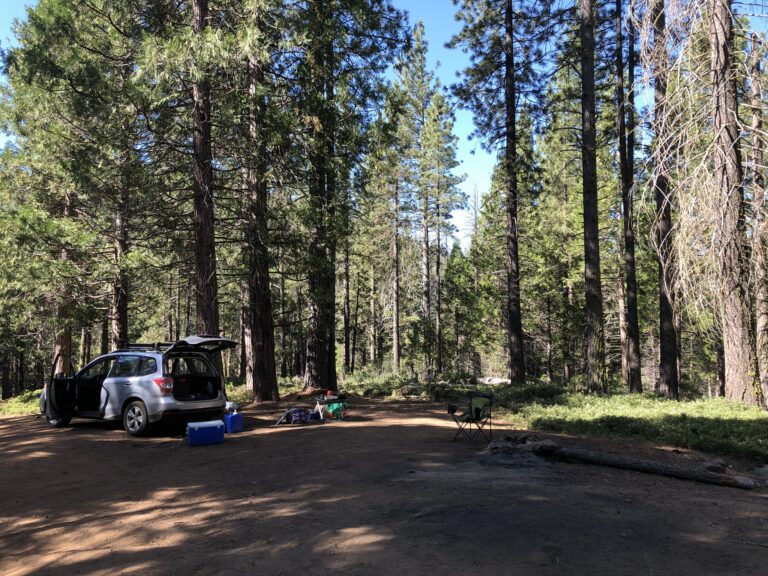
- Car camping: Driving up to a camping area and packing your gear in a car. This can be at a designated campground, primitive campground, or on your own as dispersed camping. Ultimately, anywhere you camp with your car is “car camping.”
- Backpacking: Where you travel only by foot and carry all your gear, food, and supplies in a backpack. You could backpack to a dispersed camping area, developed campground, or primitive campground.
- Solo camping: Where you do any of the above, but by yourself. Why does this need a distinct category? Because it requires a different level of planning, resourcefulness, and skills that is worth reviewing independently.
- Other types of camping available in National Forests:
- Bike packing
- Pack rafting
- Glamping
- RV camping (boondocking)
- Animal packing
- Cowboy camping
Where You Can Camp On Public Lands
- Developed campgrounds: A designated camping area with basic amenities and facilities usually including fire rings, vault toilets (no water or flushing), tent platforms, potable water spigots, firewood for sale, and picnic tables. Oftentimes a campground host will be present to answer questions and collect fees. Amenities and facilities will vary depending on the campground. Many times, these campgrounds will have electric sites and hookups for RV’s and trailers.
- Primitive campgrounds: A designated camping area with little to no amenities or facilities, usually just a place to set up your tent. You may get lucky with a fire ring, but these campgrounds are mainly to provide safe areas for people to camp in more remote places and to help protect the landscape and wildlife by preventing excessive dispersed camping. These can be found on Forest Service Roads or trails.
- Dispersed camping: Also known as backcountry camping or wild camping, this is camping on any public land without any developed campgrounds, facilities, or amenities. You establish your own campsite, or find one already established by previous campers. This can be done in your car down public access roads, by backpacking, bike packing, or horseback, pack raft, and other means.
Rules And Regulations On Public Lands
Each public land has its own distinct rules and regulations, so it is essential to check with local rangers and sources no matter where you’re exploring.
Below are some general rules and regulations you’ll see enforced on most public lands:
- Leave No Trace Principles
- Fire
- Build fires only where allowed.
- Fully extinguish fires before leaving.
- Follow all fire restrictions and bans.
- Camping
- Camp at least 100 feet from lakes, rivers, and streams.
- Dispersed camping is generally allowed unless posted otherwise.
- Do not clear vegetation or damage natural features.
- Roads and Vehicles
- Drive only on roads and trails designated as open on the Motor Vehicle Use Map (MVUM).
- Roads not shown on the MVUM are closed to motor vehicles.
- Trash
- Pack out all trash, food scraps, and gear. There is NO TRASH SERVICE.
- Natural and Cultural Resources
- Do not cut standing trees or remove plants, rocks, or artifacts.
- Leave historic and cultural sites undisturbed.
- Pets
- Keep pets under control and follow posted leash rules.
- Human Waste
- Use toilets when available.
- Otherwise, dig a proper cat hole, or use wag bags and carry out your waste.
Reservations, Permits, And Passes For Public Lands
Each public land has its own system for reservations, permits and passes, so it is essential to check with local rangers and sources no matter where you’re camping. Below are some general guidelines for reservations and passes on most public lands:
Reservations
- Reservations are required for developed campgrounds, cabins, and certain overnight camping options.
- Reservations require a fee, which can vary anywhere from $5 to $50+.
- Most reservations for campgrounds can be made on rec.gov, while some are on a first-come, first-served basis.
- Most campgrounds have seasonal closures during the winter or extreme weather months.
Permits
- Permits may be required for overnight backpacking and camping trips, especially when accessing places like Wilderness Areas or highly popular trails.
- Permits require a fee, which can vary from $5 to $50+.
- Permits often have a daily cap, and may require a lottery drawing.
- Many permits can be secured on rec.gov, while others are only available at local Ranger Stations.
Passes
- Annual passes like the America the Beautiful pass provide access to all federally managed lands including National Parks, National Forests, BLM Land, National Monuments, typically covering entrance fees or day use fees.
- However, these passes do not cover the fees for campsites or permits.
Stewardship & Etiquette For All Public Lands
To enjoy camping unless we all must make an effort to keep these places clean, safe, and accessible. Like riding a bus, you’re in the public arena when camping and your presence always makes an impact. What kind of impact is up to you.
General Stewardship And Etiquette
- Understand the Leave No Trace Principles
- Keep light levels reasonable and respectful, especially floodlights.
- Keep noise levels reasonable and respectful, especially music.
- Do not ever feed, approach, or disturb any wildlife.
- Pack everything out, including trash.
- Do not book extra campgrounds that you don’t need.
- Leave the place better than you found it.
Car Camping Stewardship And Etiquette
- Do not leave your car running or your headlights on.
- Park in proper pull-offs and not on sensitive vegetation.
- Do not steal other campers’ parking spots for convenience.
Backpacking Stewardship And Etiquette
- If dispersed camping, try to find and utilize an already established camping spot.
- Do not cut trails or switchbacks. This is very dangerous and damaging.
- Do not disturb trail markers or cairns.
- Do not play music loudly unless necessary for safety (like in bear country).
What To Expect When Camping On Public Lands
With such a variety of landscapes, rules, and access, you can expect a variety of situations from sharing the spaces with other outdoor adventurers, encountering wildlife, being far from any amenities, or getting stuck in extreme conditions. In any case, it’s good to set some general expectations no matter where you’re camping.
General Camping expectations
- It always requires some hard work.
- There will be bugs.
- There will be bad weather.
- There will be spooky sounds.
- You will get dirty and smell.
- You will forget something.
- Your feet, back, and shoulders may be sore.
- It can feel a little scary at first.
- Weather exposure and falling tree limbs are way more of a threat than animal encounters.
- You will have a lot of fun.
How To Plan A Camping Trip On Public lands
- Determine which public land you’d like to explore
- National Forest
- National Park
- BLM Land
- Other?
- Determine what type of camping you want to do:
- Car camping
- Backpacking
- Other
- Determine where you will camp:
- Developed campground
- Primitive campground
- Dispersed camping
- Call the local Ranger Station or public land websites for:
- Fire restrictions
- Road access
- Trail access
- Weather conditions (snow, rain, wildfire watch)
- Purchase any fees, reservations, or permits required
- Learn the rules/etiquette of where you are camping
- Plan out your meals
- Test out your gear
- Let people know where you’re going
- Enjoy the journey
A Note On Public Lands Today
Public lands in the United States exist because people chose long-term care over short-term gain. Lands that had been previously been stewarded for generations by Indigenous nations. That protection is never guaranteed. It depends on laws, funding, leadership, and public attention.
Unfortunately, recent decisions have weakened protections and increased pressure from extractive use and private enterprises, putting ecosystems, natural resources, wildlife habitat, cultural and historical sites, local economies, and public access and benefits at major risk.
If you appreciate public lands and the benefits they provide to all of us, then please take action and support them no matter how big or small your contribution.